
 Português
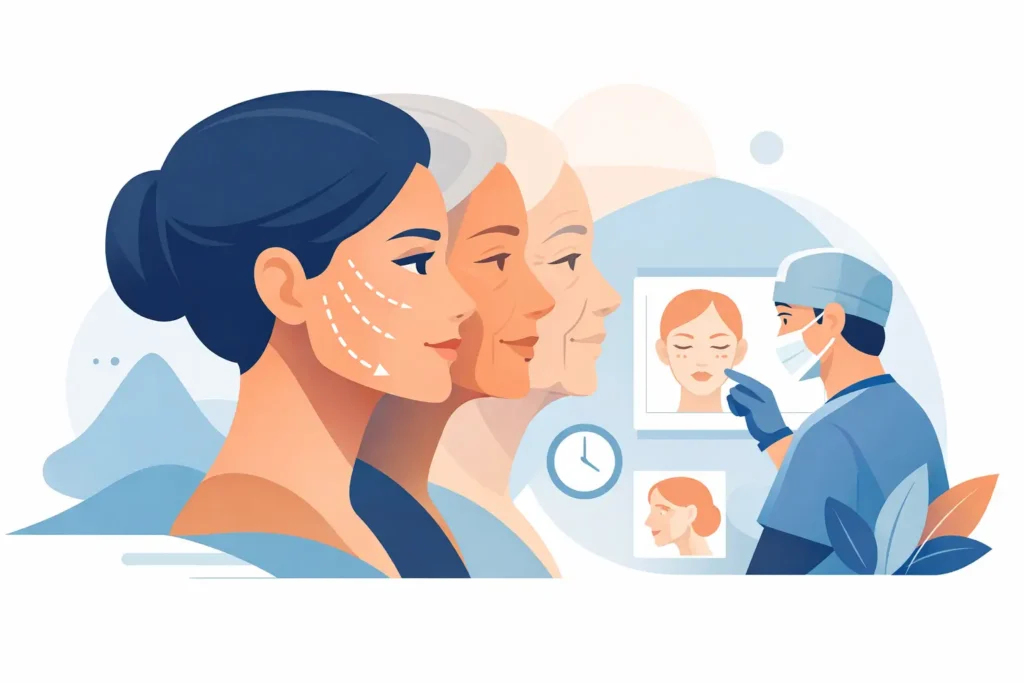
A common question in facial rejuvenation consultations is simple but deeply personal: what is the best age for facelift surgery? Most patients are not asking for a number alone. They want to know when surgery will look refined, when it will feel worthwhile, and when it can still preserve the character of their face rather than change it.
The most honest answer is that there is no single perfect age. For many patients, the ideal window falls somewhere between the mid-40s and early 60s, but timing depends far more on anatomy, skin quality, facial volume loss, and the degree of laxity than on birthdays. A well-timed facelift is not about looking different. It is about restoring definition with precision, so the result appears rested, elegant, and naturally your own.
What is the best age for facelift surgery?
For most healthy adults, the best age for facelift surgery is the age at which facial aging becomes visible enough that non-surgical treatments no longer provide the level of improvement they want. That often happens in the late 40s or 50s, when the jawline softens, deeper folds appear around the mouth, the neck begins to lose definition, and the midface descends.
This does not mean every patient should wait until those changes become advanced. In fact, patients who choose surgery a little earlier often benefit from a more subtle correction and a smoother long-term aging trajectory. When tissues still retain reasonable elasticity, the surgeon can reposition and refine with less tension on the skin, which supports a more natural result.
On the other hand, being older does not mean you have missed your opportunity. Many patients in their 60s and even beyond are excellent candidates if they are in good health and have realistic expectations. The right procedure, performed with meticulous technique, can restore harmony beautifully at that stage as well.
Why age alone is not the deciding factor
Two patients can be 52 and look completely different anatomically. One may have early jowling and strong skin quality. The other may have significant neck laxity, deeper folds, sun damage, and volume loss. Genetics, weight fluctuations, smoking history, sun exposure, and bone structure all influence how the face ages.
This is why an expert consultation matters so much. A surgeon does not evaluate your face according to age brackets alone. He evaluates the underlying structures, skin behavior, fat distribution, muscle support, and the relationship between the cheeks, jawline, and neck. That detailed assessment is what determines whether a facelift is appropriate now, whether it should be combined with another procedure, or whether a patient would benefit from waiting.
In elegant facial surgery, timing is not about chasing an arbitrary age. It is about intervening at the moment when surgery can create a meaningful improvement while still maintaining softness and authenticity.
Facelift timing by decade
In your 40s
Patients in their 40s often notice early descent in the cheeks, loss of jawline sharpness, or a tired appearance that fillers and skin treatments no longer fully correct. This can be an excellent time for facial rejuvenation if laxity is beginning to develop but has not become severe.
The advantage of operating in this range is subtlety. Because the aging changes are often moderate, the result can be exceptionally natural. Friends may notice that you look refreshed or more defined without immediately assuming surgery. The trade-off is that some patients in their early 40s are still better served by less invasive options if skin tone remains strong and structural sagging is limited.
In your 50s
For many patients, this is the classic facelift decade. By this stage, jowls are more established, the neck may show banding or fullness, and facial descent becomes difficult to camouflage. A facelift performed at this point often offers a clear, satisfying change while still preserving natural contours.
This age range is frequently ideal because the signs of aging are visible enough to justify surgery, but tissue quality is often still favorable. It is also a time when many patients feel ready to invest in longer-lasting rejuvenation rather than maintain a cycle of temporary treatments.
In your 60s and beyond
Patients in their 60s often seek a more comprehensive correction of the face and neck. This can still yield beautiful, sophisticated outcomes, especially when surgery is tailored to the full pattern of aging rather than limited to the skin alone.
The main consideration at this stage is not age itself, but health status, healing capacity, and the extent of volume loss or skin damage. Some patients will need a more complete plan, potentially including eyelid surgery, fat grafting, or skin resurfacing, to achieve balanced rejuvenation. When those elements are thoughtfully combined, the result can be both transformative and refined.
Signs you may be ready for a facelift
There are a few clues that matter more than your age. One is when your lower face looks heavy or tired even when you are well rested. Another is when makeup, skincare, injectables, or energy-based treatments no longer address the problem you actually see in the mirror.
The mirror test is often revealing. If you gently lift the skin and soft tissue near the cheeks and jawline and you like the restored contour, that suggests facial descent may be the issue. A facelift addresses sagging tissue. It does not replace volume where it has been lost, improve every line, or change skin texture on its own. Understanding that distinction helps patients choose the right moment and the right treatment plan.
When it may be too early
Some patients ask about facelift surgery in their late 30s or very early 40s because they want to stay ahead of aging. In select cases, earlier intervention can be reasonable, but many are not yet ideal surgical candidates. If the main concern is fine lines, mild volume loss, or skin quality rather than tissue descent, surgery may not be the best first step.
Operating too early can mean addressing a problem that is not yet structurally significant. In those situations, a thoughtful non-surgical plan may provide excellent maintenance until a facelift becomes truly beneficial. Good aesthetic judgment includes knowing when not to operate.
The best age for facelift surgery also depends on the technique
Not all facelifts are the same, and the technique matters when considering timing. Modern facial rejuvenation focuses on repositioning deeper structures rather than simply pulling the skin. This approach supports longevity and reduces the risk of an overly tightened appearance.
For patients who want a natural-looking result, the goal is never to erase identity. It is to restore architecture that has descended over time. In practice, that means the ideal age is often when those deeper changes are visible enough to benefit from surgical repositioning but before the face has become severely overtreated with temporary fixes.
This is where technical precision becomes especially important. A carefully planned procedure can enhance the jawline, soften heaviness in the lower face, and rejuvenate the neck while preserving expression and individual beauty. That balance is what sophisticated patients are usually seeking.
Questions to ask instead of focusing only on age
A more useful consultation begins with a different set of questions. Are my concerns caused by sagging, volume loss, skin damage, or a combination of all three? Will surgery create a meaningful improvement now, or should I wait? If I have surgery sooner, will the result be more subtle and easier to maintain over time?
Patients traveling for surgery often have one additional consideration: planning. If you are arranging care away from home, timing should also align with your ability to recover properly and without pressure. A high-touch surgical experience matters here. At Dr. Hebert Lamblet Plastic Surgery, that guidance is part of the overall standard of care, particularly for international patients seeking both expertise and peace of mind.
A well-chosen facelift should feel like a thoughtful decision, not a rushed one. The right age is the one at which your anatomy, goals, and lifestyle align with a procedure that can deliver elegant, lasting improvement. If your reflection no longer matches how vibrant you feel, that conversation may be worth having now.
