
 Português
A face can look tired long before it looks old. Often, the change is not only skin laxity or fine lines, but a quiet loss of volume through the cheeks, temples, under-eye area, and jawline. Autologous fat grafting face treatment addresses that shift in a way many patients find especially appealing – by restoring volume with your own living tissue rather than relying solely on synthetic fillers.
For patients who want refinement, not obvious alteration, this approach offers a distinct advantage. It can soften hollowness, improve facial balance, and support a more rested appearance while preserving the character of the face. The goal is not to make someone look different. It is to bring back structure, softness, and harmony where time or weight change has taken them away.
What Is Autologous Fat Grafting Face Treatment?
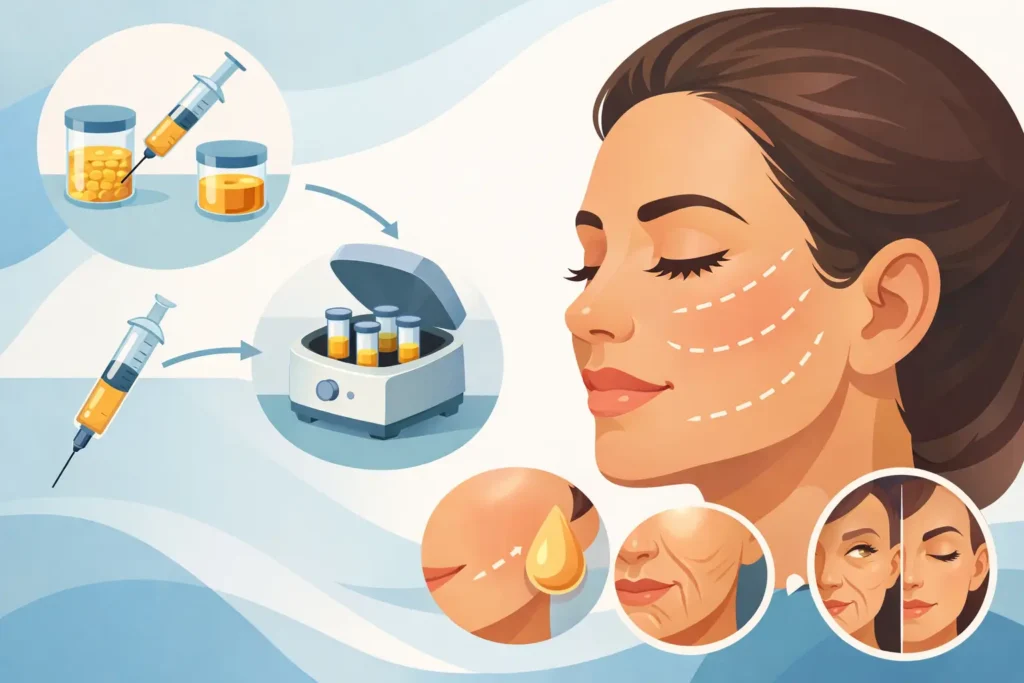
Autologous fat grafting to the face is a procedure that removes a small amount of fat from one area of the body, carefully processes it, and then injects it into selected areas of the face. Because the material comes from your own body, it is biocompatible and uniquely suited for natural-looking volume restoration.
Common treatment areas include the cheeks, temples, under-eyes, nasolabial folds, marionette lines, chin, and jawline. In some patients, fat grafting is also used to improve facial transitions rather than simply fill a single hollow. That distinction matters. A youthful face is not created by isolated fullness, but by smooth, balanced contours and light reflection across the face.
This is where surgical judgment becomes essential. The artistry lies in placing the right amount of fat at the right depth, in the right areas, so the face looks refreshed instead of overfilled.
Why Patients Choose Facial Fat Grafting
There are several reasons patients are drawn to facial fat transfer, especially when natural aesthetics are the priority.
First, the result tends to feel and look soft. Fat behaves like living tissue because it is living tissue. When grafted well, it integrates into the surrounding area in a way that can appear more organic than a highly structured filler result.
Second, it offers the possibility of longer-lasting improvement. Not all transferred fat survives permanently, and some degree of resorption is expected. Even so, the fat that establishes blood supply and survives can remain for years. This makes the procedure attractive for patients who prefer a more enduring approach to volume restoration.
Third, there is the benefit of dual treatment. A small amount of fat is harvested from a donor area, often the abdomen, flanks, or thighs, then used to enhance the face. The body contouring involved is modest, but many patients appreciate that the procedure uses their own tissue from a place where it is less desired.
Where Autologous Fat Grafting Face Results Look Most Elegant
The most elegant facial fat grafting results are often the ones no one can name. People may notice you look healthier, more rested, or subtly younger without identifying exactly why.
The cheeks are one of the most transformative areas because midface volume supports the entire face. Restoring this region can soften heaviness around the nasolabial folds and improve light reflection across the cheekbones. The temples are another area that makes a remarkable difference. Hollow temples can make the upper face look skeletal or fatigued, and careful fat placement can restore continuity between the forehead, brow, and cheek.
Under-eye treatment requires special precision. In the right candidate, fat grafting can improve the transition between the lower eyelid and the cheek, reducing a sunken or shadowed appearance. This area can also be delicate, so surgical technique and candidacy assessment matter deeply.
The jawline, chin, and lower face can also benefit, particularly when the aim is to rebalance proportions rather than simply add fullness. In select cases, fat grafting is combined with a facelift, eyelid surgery, or skin treatments to address both volume loss and tissue descent.
Fat Grafting vs Fillers
Patients often ask whether fat grafting is simply a longer-lasting version of filler. The truth is more nuanced.
Fillers are useful, versatile, and often ideal for patients who want a non-surgical treatment with minimal downtime. They can be excellent for smaller corrections, first-time treatment, or situations where reversibility matters. They also work well when someone wants a quick improvement before a major event.
Fat grafting is more involved because it is a surgical procedure. It requires harvesting, processing, and placement, and recovery is usually more noticeable than with injectable fillers alone. But it can provide a broader, more integrated restoration of facial volume, particularly for patients with generalized deflation rather than one isolated concern.
The choice depends on anatomy, goals, timeline, and tolerance for downtime. For some, filler is the right first step. For others, facial fat grafting offers a more refined and comprehensive result.
Who Is a Good Candidate?
A good candidate for autologous fat grafting face treatment is typically someone with visible facial volume loss, reasonable skin quality, and a desire for natural enhancement using their own tissue. Patients who have become hollow after weight loss or who feel their face looks tired, thin, or drawn often do especially well.
Candidates also need enough donor fat for harvesting, although the amount required for facial transfer is relatively small. Good overall health, stable weight, and realistic expectations are all important.
There are also cases where fat grafting alone may not be enough. If the main issue is significant jowling, deep tissue descent, or excess skin, a lifting procedure may be more appropriate or may be combined with fat transfer for a more complete rejuvenation plan. Volume and sagging are not the same problem, even though they often appear together.
What to Expect During the Procedure
The procedure begins with harvesting a small amount of fat from a donor area. This is done gently to preserve cell viability. The fat is then purified and prepared for transfer before being injected into the face in tiny, carefully layered amounts.
That layered technique is one of the reasons expert treatment matters so much. Overcorrection, poor placement, or uneven distribution can compromise the result. Precision affects not only how the face looks in the early healing phase, but also how well the transferred fat survives over time.
Depending on the treatment plan, facial fat grafting may be performed on its own or combined with other procedures. In a refined surgical setting, this combination approach can be especially valuable because it allows the surgeon to address multiple dimensions of facial aging with harmony rather than fragmentation.
Recovery and Healing
Recovery is usually straightforward, but it requires patience. Swelling and bruising are expected both in the donor area and in the face. The face may look fuller than the final result at first, partly due to swelling and partly because some surgeons intentionally account for partial fat resorption.
Most patients begin to look socially presentable within a couple of weeks, though subtle swelling can take longer to resolve. Final results develop gradually as the tissues settle and surviving fat establishes itself.
This is one reason the procedure appeals to patients who value elegant outcomes over instant gratification. Fat grafting rewards a measured approach. The early stage can feel uncertain, but the result often becomes more beautiful as healing progresses.
How Long Do Results Last?
This is one of the most common questions, and the honest answer is that it varies. A portion of the transferred fat will not survive. That is normal. The fat that does survive can remain long term, which is why results are often considered durable.
Longevity depends on surgical technique, blood supply in the recipient area, aftercare, and individual biology. Significant weight fluctuation can also affect the result because transferred fat behaves like fat elsewhere in the body. If you gain or lose a notable amount of weight, facial volume may change as well.
In some cases, a second session may be recommended to refine the outcome or build additional volume. That does not mean the first procedure failed. It simply reflects the reality that living tissue is dynamic and that subtle layering can produce the most natural result.
The Value of Surgical Artistry
Facial fat grafting is not only about adding volume. It is about reading the architecture of the face and understanding where support has been lost, where softness should return, and where restraint is essential. The best results come from a surgeon who respects facial identity and uses technique in service of balance.
For international patients considering surgery abroad, that judgment matters even more. A thoughtful consultation, a clear treatment plan, and attentive postoperative guidance help transform a complex decision into a confident one. In a practice such as Dr. Hebert Lamblet Plastic Surgery, where meticulous technique and natural beauty are central, facial fat grafting fits beautifully within a broader philosophy of refined rejuvenation.
If your face looks more tired, hollow, or severe than you feel, restoring volume with your own tissue can be a remarkably sophisticated answer – subtle enough to protect what makes you look like yourself, powerful enough to bring that version of you back into view.
