
 Português
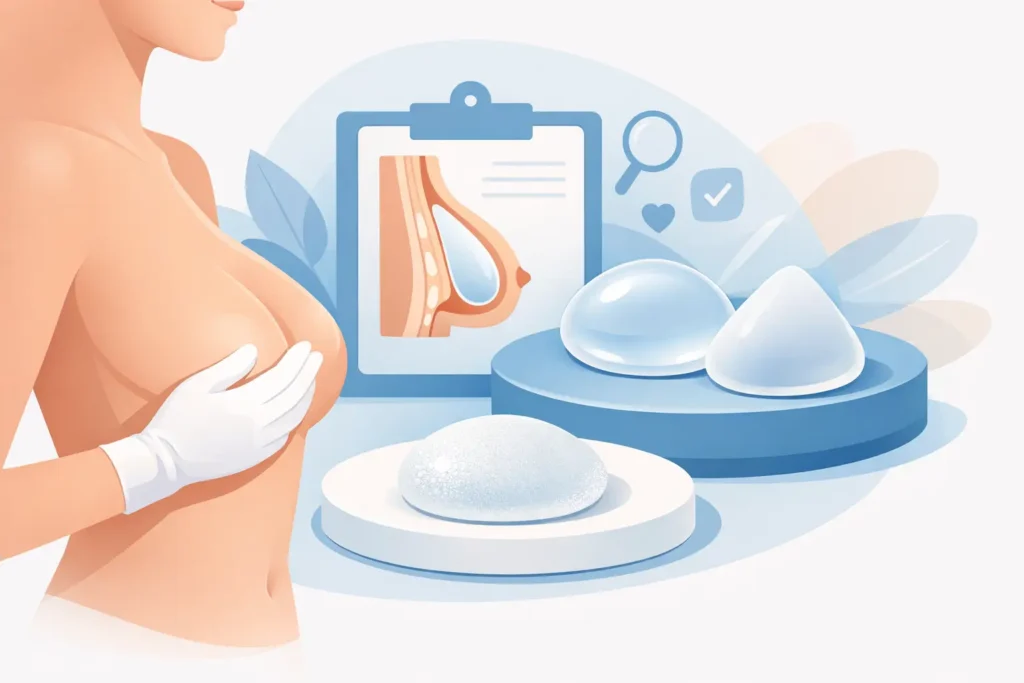
A beautiful breast augmentation is rarely defined by one decision. It is the considered relationship between your anatomy, your lifestyle, and the degree of enhancement you envision. This guide to breast implant options explains the choices that shape a refined result, so you can arrive at your consultation prepared to discuss what feels authentic to you rather than simply selecting a cup size.
For many patients, the goal is not to look augmented. It is to restore proportion after pregnancy or weight loss, bring balance to a petite frame, correct asymmetry, or feel more at ease in clothing and swimwear. The most elegant results respect the breast footprint, chest width, skin quality, and natural tissue already present.
A Guide to Breast Implant Options: Start With Your Anatomy
Implants are measured in cubic centimeters, or cc, rather than bra cup sizes. A 300 cc implant can look subtle on one patient and noticeably fuller on another because the final appearance is influenced by height, torso width, existing breast volume, and the elasticity of the skin.
During a thoughtful surgical consultation, measurements matter. Your surgeon evaluates the width of the breast base, nipple position, chest wall shape, tissue thickness, and any natural asymmetry. These details establish a safe range of implant dimensions and help prevent a result that appears too wide, too narrow, or disproportionate to your frame.
Your desired look matters equally. Some patients prefer a soft, understated contour that fills the upper breast only gently. Others want a more defined décolletage and a fuller silhouette in fitted clothing. Neither preference is inherently better. The right choice is the one that can be achieved safely while maintaining harmony with your body.
Saline and Silicone Implants
Both saline and silicone implants have an outer silicone shell, but their filling differs. The choice often comes down to feel, incision considerations, and the amount of natural breast tissue covering the implant.
Saline implants
Saline implants are filled with sterile salt water after they are placed, which may allow for a smaller incision in certain cases. If a saline implant ruptures, the body safely absorbs the solution and the breast typically loses volume relatively quickly, making the change apparent.
For patients with limited natural breast tissue, however, saline can be more likely to show rippling or feel less like natural breast tissue. This does not make saline the wrong choice, but it is a meaningful consideration for very lean patients or those seeking the softest possible result.
Silicone gel implants
Silicone gel implants are widely selected for their soft, cohesive feel and natural movement. Modern silicone gel is designed to hold together more effectively than earlier generations, particularly in cohesive and highly cohesive options. Many patients feel these implants more closely resemble the texture of natural breast tissue.
Because a silicone implant rupture may not always create an immediate visible change, periodic clinical follow-up and imaging may be recommended by your surgeon. A silicone implant is not automatically the best choice for every patient, but it is often well suited to individuals prioritizing a refined, natural-looking contour.
Implant Shape: Round or Anatomical
Round implants are the most common option in breast augmentation. They can create fullness through the center and upper portion of the breast while still looking natural when the selected size, profile, and placement suit the patient’s anatomy. They also do not create a shape concern if the implant rotates.
Anatomical implants, sometimes called teardrop-shaped implants, are fuller in the lower pole and tapered toward the top. For select reconstructive or aesthetic cases, this shape may be beneficial. However, because the implant has a fixed orientation, rotation can alter the breast shape and may require correction. In many cosmetic augmentations, a carefully chosen round implant provides a beautifully natural result without this particular concern.
The shape of an implant does not dictate your entire outcome. Surgical planning, the existing breast tissue, and how the implant settles during healing all play significant roles.
Profile Determines Projection
Profile refers to how far the implant projects forward from the chest wall in relation to its width. Common descriptions include low, moderate, moderate-plus, and high profile, though terminology varies by manufacturer.
A lower-profile implant has a broader base and gentler projection. It may suit a wider chest or a patient seeking a subtle enhancement. A higher-profile implant offers more forward projection within a narrower base, which can be appropriate for patients who want a fuller look without choosing an implant that extends too far toward the sides of the chest.
High profile does not necessarily mean oversized, and moderate profile does not necessarily mean natural. An implant can look graceful or conspicuous at any profile depending on the patient’s proportions. This is why selecting an implant solely from photographs can be misleading. Images are useful for communicating preference, but precise measurements should lead the plan.
Placement Above or Below the Muscle
Implants may be placed above the pectoral muscle, known as subglandular placement, or partially beneath it, often called dual-plane placement. The best option depends on tissue coverage, athletic activity, breast shape, and the presence or absence of breast laxity.
Above-the-muscle placement can provide a direct, defined shape and may involve less disruption of the chest muscle. It is often considered for patients with sufficient natural tissue to cover the implant well. In patients with thin tissue, however, edges or rippling may be more visible.
Dual-plane placement combines coverage from the pectoral muscle in the upper breast with surgical release that allows the lower breast to shape naturally over the implant. It can be an excellent option for patients with limited upper-pole tissue or mild sagging. For highly active athletes, the possibility of movement with chest-muscle contraction deserves an honest conversation. There is no universal placement that is best for every body.
When an Implant Alone Is Not the Complete Answer
An implant adds volume, but it does not lift a breast that has significantly descended. After pregnancy, breastfeeding, major weight change, or natural aging, the nipple and breast tissue may sit lower than desired. In these circumstances, a breast lift with implants may create a more balanced and lasting result than increasing implant size alone.
Some patients may also benefit from fat grafting as an adjunct to implants. Carefully placed fat can soften transitions at the upper breast or cleavage area and refine mild asymmetry. It is not a replacement for an implant when substantial volume is desired, and not all transferred fat survives, but it can be valuable in a tailored treatment plan.
Safety, Longevity, and Future Planning
Breast implants are medical devices, not lifetime devices. Some patients enjoy their results for many years without revision, while others may eventually need surgery because of capsular contracture, rupture, changes in breast tissue, a shift in aesthetic preference, or life events such as pregnancy and weight fluctuation.
A capsule naturally forms around every implant. In some cases, that capsule can tighten and make the breast feel firm, change shape, or become uncomfortable. This is called capsular contracture and may require treatment. Other risks include bleeding, infection, changes in nipple sensation, asymmetry, visible rippling, and implant malposition. A responsible consultation addresses these possibilities directly, along with the rare implant-associated conditions that have been linked to certain textured implant surfaces.
Choosing a board-certified plastic surgeon with extensive breast surgery experience is central to reducing avoidable risk and developing a plan that remains appropriate over time. At Dr. Hebert Lamblet Plastic Surgery, the emphasis is on precise planning, natural proportion, and attentive guidance before and after surgery, including for patients traveling to Brazil for care.
Prepare for a More Productive Consultation
Bring photographs that communicate the feeling you want, such as soft fullness, athletic balance, or a more pronounced décolletage. They should be used as a starting point, not a promise that another person’s result can be replicated on a different body.
Be ready to discuss your medical history, prior breast procedures, pregnancy plans, weight stability, exercise routine, and expectations for recovery. Ask how the recommended implant width, projection, material, and placement were chosen for you. You should also understand the incision approach, recovery restrictions, follow-up schedule, and what future monitoring may involve.
The most satisfying breast augmentation does not begin with the largest implant that fits. It begins with a clear understanding of your options and a surgical plan designed to let you feel like yourself, only more confidently proportioned.
