
 Português
When the upper eyelid begins to rest too heavily over the lash line, the face can look tired even when you feel fully rested. For many patients, blepharoplasty for hooded eyes is not about changing their identity. It is about restoring visible lid space, softening a weighed-down appearance, and bringing the eyes back into harmony with the rest of the face.
Hooded eyes can be beautiful and entirely natural. In some people, they are simply part of inherited anatomy. In others, the hooding becomes more pronounced with age as skin stretches, soft tissue descends, and the brow position changes. The question is not whether hooded eyes need correction. The real question is whether excess skin or fullness is making the eyes look heavy, obscuring makeup, interfering with vision, or creating an appearance that no longer reflects how you see yourself.
What blepharoplasty for hooded eyes can address
Upper eyelid blepharoplasty is designed to remove or reposition excess tissue from the upper lids. In patients with hooded eyes, this often means carefully reducing loose skin and, when appropriate, refining pockets of fat that create puffiness. The goal is not to hollow the eye or erase natural character. The goal is a cleaner upper lid contour with a more open, refreshed expression.
That distinction matters. Hooding can come from several sources, and each requires a slightly different surgical judgment. Some patients mainly have skin redundancy. Others have fullness from protruding fat. Some have a low or descending brow that pushes tissue downward onto the lid. If the brow is the primary issue, eyelid surgery alone may help, but it may not create the most balanced result. This is where experience and restraint become especially important.
A well-planned procedure respects the relationship between the eyelid, brow, forehead, and upper face. Beautiful results rarely come from removing as much as possible. They come from knowing exactly how much to remove, what to preserve, and how to maintain a natural look in motion and at rest.
Are hooded eyes always a surgical concern?
Not always. Some patients love the look of their hooded eyes and have no reason to change them. Others notice practical frustrations before they think about aesthetics at all. Eyeliner transfers. Eyeshadow disappears into the crease. Mascara touches the skin above the lashes. In more advanced cases, upper lid heaviness can contribute to a narrowed field of vision or a constant sensation of tiredness around the eyes.
Surgery becomes worth considering when the anatomy feels limiting rather than simply distinctive. Age often plays a role, but younger patients can be candidates too, especially when hooding is genetic and pronounced. The decision is personal, and the right timing depends on anatomy, goals, and how much change you want.
Common signs that upper lid hooding may be ready for evaluation
You may benefit from a surgical consultation if you notice that the upper lid skin folds over the natural crease, your eyes appear persistently tired or heavy, or your upper lid makeup space has gradually disappeared. Some patients also feel they need to raise their brows constantly to look more awake, which can create forehead tension over time.
These signs do not automatically mean surgery is necessary, but they do suggest that a precise assessment could be useful.
What happens during surgery
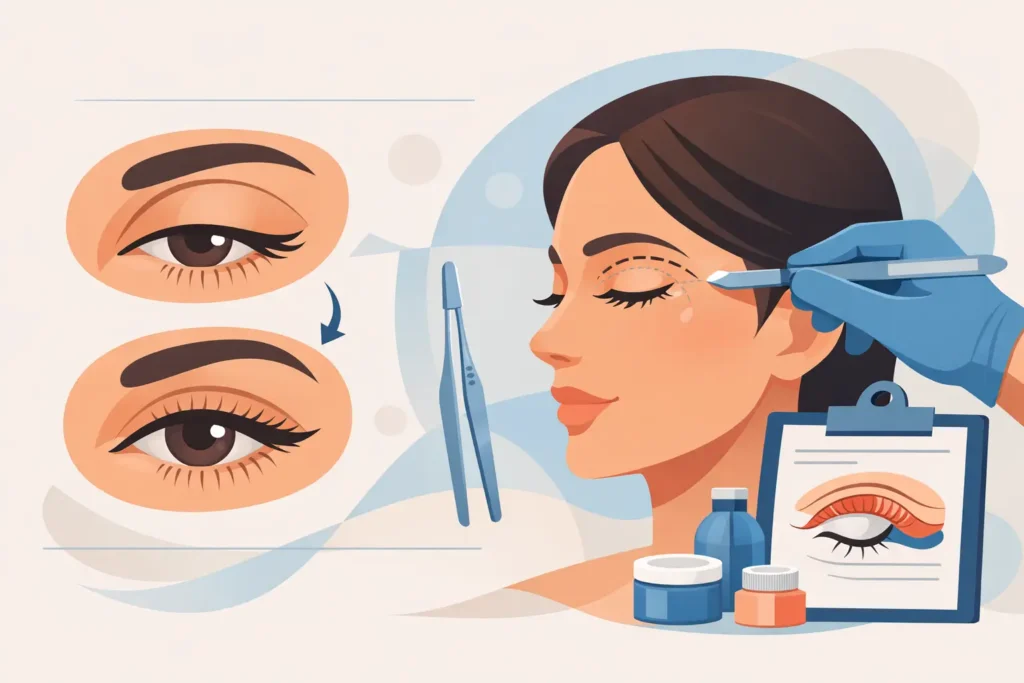
Blepharoplasty for hooded eyes is typically performed by placing a carefully planned incision within the natural upper eyelid crease. Through this opening, excess skin is removed and, when needed, underlying fat is conservatively reduced or reshaped. In some patients, a small amount of muscle is refined as well.
The details matter more than the general concept. Eyelid skin is delicate, and even a small miscalculation can affect the final look. Too little correction may leave the lid still feeling heavy. Too much can create an over-operated appearance or interfere with natural eyelid closure. The best outcomes depend on precision, not aggressiveness.
Because the incision is hidden in the natural crease, the scar usually heals discreetly. As recovery progresses, most patients find that the scar becomes difficult to detect when the eyes are open.
What results should look like
The most elegant eyelid surgery is often the least obvious to others. Friends may say you look rested, lighter, or somehow more refreshed without immediately identifying why. That is often the ideal outcome.
For hooded eyes, the improvement usually includes more visible upper lid space, a smoother contour above the lashes, and less heaviness in the outer or central upper lid. The eyes may appear brighter and more defined, but still entirely your own. A refined result should match your facial structure, your age, and your aesthetic style.
It is also important to understand what upper blepharoplasty does not do. It does not lift the brow significantly on its own, and it does not address lower eyelid puffiness or under-eye hollowness. If those concerns are present, a broader facial plan may be more appropriate than treating the upper lids in isolation.
Recovery after blepharoplasty for hooded eyes
Recovery is usually more manageable than many patients expect, although the first week still requires care and patience. Swelling and bruising are common, particularly in the first several days. The eyes may feel tight, dry, or mildly irritated while healing begins. Most patients are comfortable resting at home and gradually returning to light routine activity as swelling improves.
Sutures, if used externally, are typically removed within about a week. Many patients feel socially presentable soon after that point, though subtle swelling can linger longer. Final refinement takes time. The eyelids continue to settle, soften, and mature over several weeks to months.
For international patients, planning matters. Travel timing, recovery support, and follow-up should be organized in advance so the experience feels calm rather than rushed. This is one reason many patients seek a practice that offers not only surgical expertise, but attentive coordination throughout the journey.
A few recovery realities worth knowing
Swelling is not perfectly symmetrical in the first days, and that alone should not cause alarm. The eyelids also heal on a very fine aesthetic margin, so early impressions are rarely the final result. Protecting the incision, limiting strain, and following postoperative instructions closely all support a smoother recovery.
Choosing the right surgeon for hooded eyes
This procedure may sound straightforward, but eyelid surgery is one of the most detail-sensitive operations in facial aesthetics. The upper eyelid plays a central role in expression. Millimeters matter. So does the surgeon’s judgment about when not to overcorrect.
If you are considering blepharoplasty for hooded eyes, look for a surgeon with deep knowledge of facial anatomy, a refined aesthetic eye, and a clear philosophy around natural results. This is especially important if your hooding is paired with brow descent, asymmetry, previous eyelid surgery, or ethnic anatomical features that should be respected rather than standardized.
A consultation should feel thoughtful, not rushed. You should come away understanding whether the issue is skin, fat, brow position, or a combination of factors. You should also hear an honest discussion of trade-offs. In some faces, a subtle correction is the elegant choice. In others, combining procedures creates a more complete and lasting improvement.
At a practice such as Dr. Hebert Lamblet Plastic Surgery, that level of planning is central to the experience. Patients who travel for surgery often want two forms of confidence at once – confidence in the surgeon’s technical precision and confidence in the process surrounding their care.
Is blepharoplasty for hooded eyes worth it?
For the right patient, it can be remarkably rewarding because the change affects both expression and self-perception. The mirror looks less tired. The eyes feel less hidden. Makeup sits better. Photographs feel more familiar again. Yet worth is never measured by trend or before-and-after drama. It depends on whether the heaviness you see has become a real concern for you.
The best candidates usually want refinement, not reinvention. They are looking for a fresher upper eyelid contour that still feels believable, elegant, and personal. When surgery is tailored carefully, that is exactly what upper blepharoplasty can provide.
If your eyes have begun to feel overshadowed by excess upper lid skin, the most useful next step is not guessing from photos. It is a precise evaluation of your anatomy, your goals, and the kind of result that will still feel like you years from now.
