
 Português
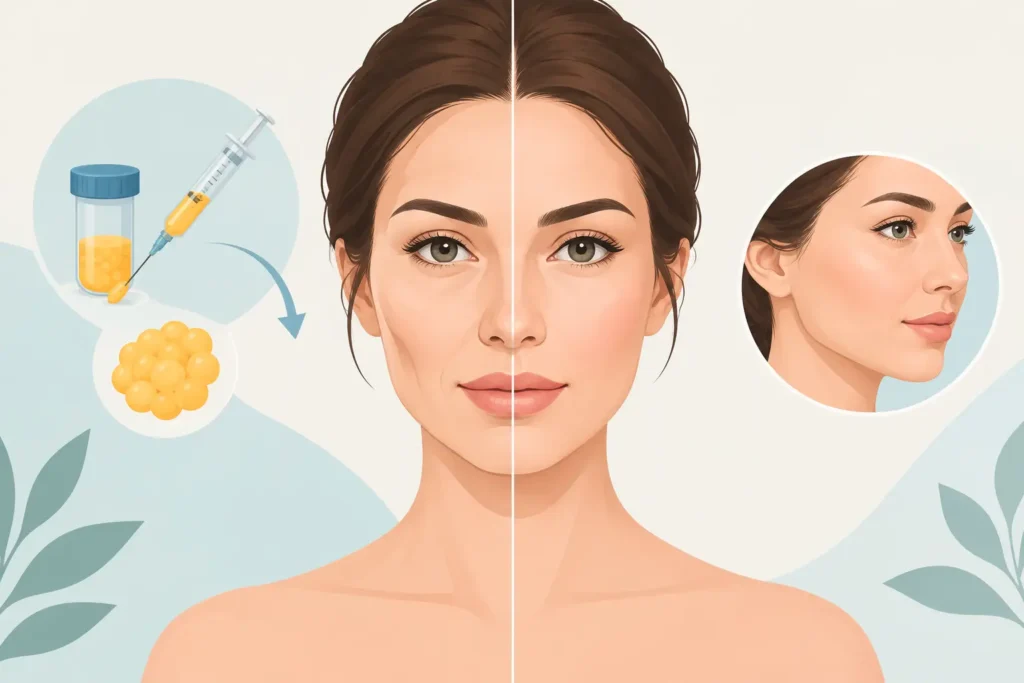
A face can appear tired not because the skin has suddenly changed, but because it has gradually lost the soft volume that once supported the cheeks, temples, under-eye area, and jawline. Facial fat grafting outcomes are valued for addressing this change with your own living tissue, creating refinement that can feel more like restoration than alteration.
For patients who want to look rested, balanced, and naturally refreshed, fat transfer offers a distinctive approach to facial rejuvenation. Yet beautiful results depend on more than the procedure itself. The quality of the harvested fat, the precision of placement, your individual healing response, and thoughtful expectations all shape the final result.
What facial fat grafting is designed to improve
Autologous fat grafting uses fat harvested from another area of the body, commonly the abdomen, flanks, or thighs. After the fat is carefully processed, it is placed in small, controlled amounts into areas of facial volume loss or imbalance. Because the material comes from your own body, it can integrate naturally with surrounding tissue.
The treatment is often considered for hollow temples, flattened cheeks, tear troughs, nasolabial folds, marionette lines, lips, and subtle contour irregularities. In some patients, it can also enhance the softness around the jawline or restore gentle fullness that has diminished with age or weight loss.
The goal is not to make the face look overfilled. A meticulous surgeon uses fat grafting to respect facial proportions, light reflection, and the character of each patient’s features. The finest results are often the ones others notice only as a more rested appearance, clearer contour, or renewed vitality.
Facial fat grafting outcomes are not immediate
The first days after treatment do not reveal the final result. Swelling, bruising, and temporary fullness are expected, particularly around delicate areas such as the lower eyelids and cheeks. The donor area may also be sore or swollen, much like it is after a focused liposuction procedure.
During the first two weeks, the face begins to settle, although residual swelling can remain. Most patients are comfortable returning to many social and professional activities within this period, depending on the extent of treatment and their personal recovery pace. Makeup may help camouflage remaining bruising once the incisions have appropriately healed and your surgeon approves its use.
By six to twelve weeks, the contours are usually much more representative of the outcome. Fat cells that establish a blood supply are more likely to remain long term. Refinement continues over several months as swelling resolves and the grafted tissue becomes part of the facial landscape.
Why some volume is intentionally overcorrected
Not every transferred fat cell will survive. This is a normal biological reality, not a sign that the procedure has failed. A skilled surgeon accounts for expected resorption while avoiding excessive placement, which can compromise refinement and make correction more difficult.
Early fullness may therefore be purposeful. The objective is to achieve a balanced result once the healing process is complete, rather than to judge the procedure while swelling and resorption are still evolving.
What influences fat survival and longevity
There is no universal retention percentage that applies to every patient, every facial area, or every technique. Published figures can be useful for general education, but they cannot predict an individual outcome with precision. The face is not a single uniform surface, and areas with different movement, blood supply, and tissue thickness may retain volume differently.
The surgeon’s technique is central. Gentle fat harvesting, careful purification, and placement of very small parcels of fat in multiple layers can support more reliable integration. This requires patience and detailed anatomical knowledge. It is not simply a matter of adding volume.
Your health and lifestyle also matter. Smoking and nicotine exposure can affect circulation and healing, which is why patients are generally asked to stop well before surgery and throughout the recovery period. Significant weight fluctuation after surgery may also change the appearance of grafted fat, since surviving cells can respond to weight changes like fat elsewhere in the body.
Age, skin quality, prior procedures, scar tissue, and the degree of existing volume loss may influence planning as well. A patient with mild temple hollowing has different needs from someone seeking structural rejuvenation after substantial facial aging or weight loss.
Natural-looking results require disciplined planning
Facial fat grafting is especially appealing to patients who prefer an alternative or complement to synthetic fillers. It can create softness across broader areas and may offer enduring improvement once the graft has stabilized. At the same time, it is not automatically the best choice for every concern.
Dermal fillers can be more appropriate when a patient wants a highly targeted adjustment, a temporary trial of volume, or a nonsurgical option with little downtime. Fat grafting may be better suited to broader facial deflation, patients already undergoing another procedure involving liposuction, or those seeking a more comprehensive restoration using their own tissue.
For deeper laxity of the cheeks, jowls, or neck, volume replacement alone will not create the lifting effect of a facelift. In carefully selected patients, fat grafting may be combined with a Deep Plane facelift, eyelid surgery, or other facial procedure to address both position and volume. The best plan begins with an honest assessment of what is causing the aged or tired appearance.
The value of an individualized facial analysis
A beautiful face is not built from a standard set of injection points. During consultation, an experienced plastic surgeon evaluates skeletal structure, skin thickness, asymmetry, facial movement, areas of shadow, and the relationship between the forehead, eyes, cheeks, lips, and jawline.
This broader analysis prevents a common mistake: treating a visible hollow in isolation. Under-eye darkness, for example, may relate to tear trough volume loss, cheek descent, skin quality, pigmentation, or a combination of factors. Treating only one element can leave the overall concern unchanged or create imbalance.
Patients should also be candid about former fillers, facial surgeries, medical conditions, medications, and smoking history. Clear information allows the surgical plan to be safer and more exact.
Understanding the trade-offs before choosing fat transfer
Fat grafting carries the usual considerations of surgery, including anesthesia, swelling, bruising, infection, bleeding, asymmetry, contour irregularities, and the possibility that a portion of the transferred fat will not persist. Rarely, additional treatment may be recommended if volume retention is less than anticipated or if refinement is desired after healing.
There is also a practical trade-off: fat grafting requires a donor site. For many patients this is a welcome benefit, since localized fat is removed from an area of concern. However, it should never be viewed as a substitute for major body contouring or weight-loss treatment. The amount harvested is determined by safe surgical planning and the needs of the face.
The procedure rewards patience. If you are seeking instant final results before an upcoming event, a temporary nonsurgical treatment may be a more practical choice. If you value gradual, nuanced restoration and are prepared for a proper recovery period, fat grafting can be an elegant option.
Preparing for a confident recovery
Recovery instructions are tailored to the procedure and whether fat grafting is performed on its own or alongside other surgery. Patients are typically advised to protect the face from pressure, avoid strenuous activity for the period specified by their surgeon, follow medication instructions carefully, and attend follow-up appointments so healing can be monitored.
For international patients traveling to Brazil, planning deserves the same attention as the surgical plan. Allow enough time near the practice for initial recovery and postoperative evaluation before flying home. Arrange accommodations that make rest easy, bring a trusted companion when possible, and communicate your travel dates early so your care team can help structure a responsible timeline.
At Dr. Hebert Lamblet Plastic Surgery, facial rejuvenation planning is guided by precision, proportionality, and attentive support from consultation through recovery. The aim is never to erase identity. It is to preserve what is distinctly yours while restoring the volume and harmony that help you feel recognized in the mirror.
The most helpful next step is a personal consultation with a board-qualified plastic surgeon who can assess your facial anatomy, discuss your goals with candor, and explain whether fat grafting alone, another treatment, or a thoughtful combination is most likely to serve you well.
