
 Português
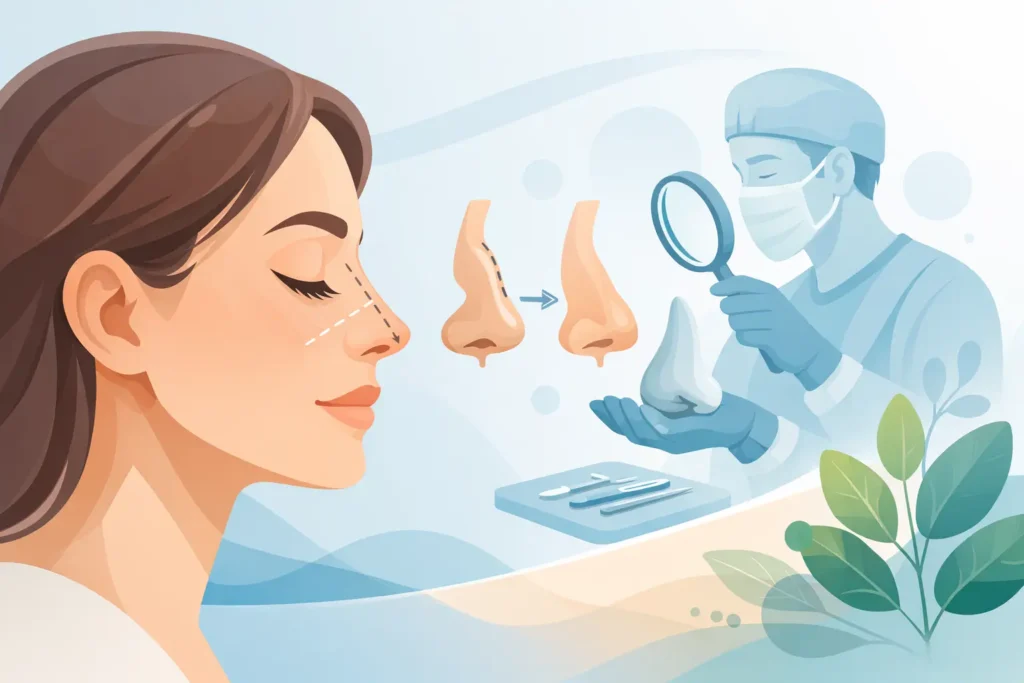
The best rhinoplasty is often the one no one notices. Friends may say you look refreshed, more balanced, or somehow more confident, without immediately identifying why. That is the goal of rhinoplasty for natural results – not a nose that looks “done,” but one that belongs to your face.
For many patients, this is the central concern before surgery. They may want to soften a dorsal hump, refine a bulbous tip, improve breathing, or correct asymmetry, but they do not want to lose character. They want elegance, not uniformity. Natural rhinoplasty respects that difference.
What rhinoplasty for natural results really means
A natural result is not defined by making the nose as small as possible or by following a single ideal shape. It means creating harmony between the nose and the rest of the face while preserving identity. The nose should suit your eyes, lips, chin, skin thickness, facial proportions, and even your expressions when you speak or smile.
This is why two patients with the same concern may need very different surgical plans. A high bridge that appears strong on one face may look perfectly balanced on another. A tip that seems wide in photographs may actually need structural support rather than aggressive reduction. Natural results come from individualized judgment, not from trends.
In practice, this often means making selective changes. Refining the bridge slightly instead of removing too much. Adjusting tip definition without pinching it. Correcting deviation while keeping the nose strong and functional. The most refined outcomes are usually measured, not dramatic.
The surgeon’s approach matters more than the trend
Rhinoplasty is one of the most nuanced procedures in facial plastic surgery because the nose is both aesthetic and functional. It must look beautiful, but it must also support breathing and heal predictably over time. Natural-looking work depends on precise technique, a deep understanding of structure, and restraint.
When a surgeon prioritizes natural aesthetics, the plan usually begins with anatomy rather than a fashion reference. Bone, cartilage, skin quality, internal support, and ethnic or inherited facial features all shape what should be done and what should be left alone. This is especially important for patients who want refinement without erasing the qualities that make them recognizable.
An overly reduced nose can look appealing in the first weeks to an untrained eye, but long-term issues may emerge. Pinching, collapse, an unnatural slope, or visible asymmetry can become more obvious as swelling settles. A natural rhinoplasty aims for durability as well as immediate beauty.
Why facial harmony matters more than a “perfect” nose
Patients sometimes bring in photos of noses they admire, and this can be helpful in discussing preferences. But the most successful consultation shifts the conversation from copying a nose to understanding proportion. A nose that is beautiful on another person may not suit your bone structure, forehead, cheek projection, or chin.
This is one reason rhinoplasty should never be planned in isolation. Small changes to the bridge, tip rotation, width, or projection can alter the entire facial impression. A balanced result can make the eyes appear brighter, the jawline more defined, and the face more refined overall, even though the surgery was limited to the nose.
For some patients, the most natural result may also involve recognizing when less is more. If a nose has strong character but remains proportionate, only modest adjustments may be needed. If the nose dominates the face or has functional issues, a more comprehensive correction may be appropriate. The right answer depends on the starting anatomy and the patient’s aesthetic goals.
How rhinoplasty for natural results is planned
Thoughtful planning is what separates a polished result from a generic one. During consultation, the surgeon evaluates the nose from all angles, including profile, frontal view, base view, and movement during expression. Breathing function matters just as much as appearance, especially when a deviated septum, internal valve weakness, or prior trauma is involved.
Skin thickness is another major factor. Thick skin can limit how sharply the tip can be defined, while very thin skin may reveal tiny irregularities beneath the surface. Neither is a problem in itself, but each requires a different strategy. Patients who understand this usually have a smoother decision-making process because expectations are rooted in anatomy, not wishful editing.
The discussion should also address what “natural” means to you personally. For one patient, it means preserving ethnic identity. For another, it means a straighter bridge and subtle tip refinement. For someone seeking revision surgery, it may mean restoring structure and softness after an unnatural prior result. These are very different goals, and they should not be treated the same way.
At Dr. Hebert Lamblet Plastic Surgery, this kind of planning aligns with a broader philosophy of refined enhancement – results designed to elevate the face without compromising individuality.
Common changes that still look natural
Many natural rhinoplasty results come from improving one or two key features rather than reshaping every part of the nose. A dorsal hump can be softened while preserving an elegant profile. A drooping tip can be lifted slightly to create a more rested expression. Wide nostrils can be reduced carefully so they remain proportionate and unobtrusive.
Straightening a crooked nose is another common goal, though it is important to understand that perfect symmetry is rarely possible in any human face. A skilled surgeon aims for visible improvement and better balance, not an artificial sense of exactness. This is one of the many areas where realistic expectations support beautiful results.
Functional improvements can also contribute to a natural outcome. If breathing is restricted, correcting internal support may enhance both appearance and quality of life. Patients often underestimate how closely these issues are connected. A nose that looks elegant but feels obstructed is not truly successful.
Recovery and when results start to look natural
Rhinoplasty requires patience. In the first days after surgery, swelling and bruising can make the nose appear larger, stiffer, or less refined than expected. This is normal. Early healing does not reflect the final result.
Most patients see meaningful improvement within the first few weeks after the splint is removed, but subtle swelling can remain for months, particularly in the tip. Thin-skinned patients may see definition earlier, while thick-skinned patients may need more time. The timeline varies, and this is one reason surgeon guidance during recovery matters so much.
Natural results emerge gradually. As swelling resolves, contours soften, balance improves, and the nose settles into the face more convincingly. This slow transition can actually be an advantage for patients who value privacy. Friends and colleagues often notice that you look better without identifying a dramatic surgical change.
Who is a good candidate for a natural-looking rhinoplasty?
The best candidates are not necessarily those seeking the smallest change. They are patients who want improvement with proportion, who understand the value of structure, and who are open to a surgical plan shaped by anatomy rather than trend images.
Good candidates are generally in good health, have fully developed facial structures, and have clear reasons for surgery. They may dislike a hump, feel their tip is heavy, struggle with breathing, or want to correct the effects of injury. What matters is that their goals are specific and realistic.
Revision patients can also be strong candidates, though the surgery is often more complex. In those cases, achieving a natural result may require rebuilding support, using grafts, and correcting scar-related distortion. The process can be more involved, but for the right patient it can be profoundly worthwhile.
Choosing the right surgeon for a refined result
If your priority is natural beauty, the consultation should feel thoughtful rather than transactional. You want a surgeon who listens carefully, evaluates function as well as form, and explains what is possible with honesty. Reassurance is valuable, but precision is even more important.
Before moving forward, look for consistency in aesthetic philosophy. Do the results appear individualized? Do patients still look like themselves? Is there evidence of restraint, balance, and technical control? Those qualities matter far more than dramatic before-and-after transformations.
A refined rhinoplasty should never compete with your other features. It should support them. When performed with meticulous planning and a clear understanding of facial harmony, the result can feel less like a change in identity and more like a return to the version of yourself that always felt right.
