
 Português
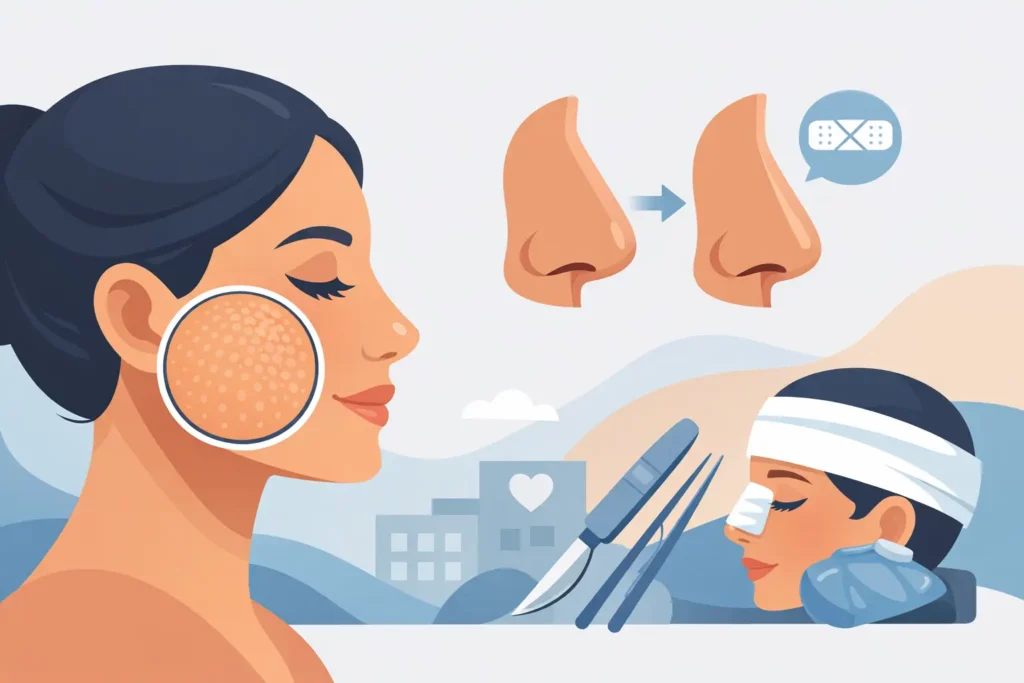
A refined nasal result is not created by reducing cartilage alone. In rhinoplasty for thick skin, the skin and soft-tissue envelope play a defining role in how much contour becomes visible after surgery. For patients who feel their tip appears broad, rounded, or less defined, the right plan begins with an honest assessment of anatomy, not a promise of an overly narrow nose.
Thicker nasal skin is often more sebaceous and less able to drape tightly over newly shaped cartilage. This does not make rhinoplasty unsuitable. It does mean that success depends on thoughtful structural technique, careful expectations, and patience during a longer period of healing.
Why thick skin changes rhinoplasty planning
The nose is a framework covered by skin, fat, and soft tissue. When that covering is thick, subtle refinements to the framework may not show through as sharply as they would in a patient with thinner skin. This is especially relevant at the nasal tip, where patients commonly seek greater definition.
An experienced surgeon does not respond by removing excessive cartilage in pursuit of a smaller nose. Over-resection can weaken support and may create pinching, collapse, or an unnatural appearance as the tissues settle. Instead, the goal is usually to create a stable, elegant framework with enough definition to remain visible beneath the skin.
Skin thickness is only one part of the picture. Cartilage strength, nasal width, tip shape, breathing function, facial proportions, prior surgery, and ethnicity all matter. Thick skin is not a single diagnosis, and it should never be treated as a limitation that erases the individuality of a patient’s features.
What results can rhinoplasty for thick skin achieve?
Well-planned rhinoplasty can create meaningful refinement for patients with thick skin. A nose may appear more balanced from the front, the bridge may be smoother or more proportionate, and the tip can gain improved support and shape. The most beautiful outcomes preserve character while bringing the nose into better harmony with the eyes, lips, chin, and overall facial structure.
The trade-off is that results may be softer than the highly etched tip definition sometimes seen in patients with thin skin. A responsible consultation should address this directly. The aim is an improvement that looks natural in real life, not a result designed around an unrealistic edited image.
For some patients, facial balance is enhanced further by considering the chin, cheeks, or overall profile. This does not mean additional treatment is necessary. It simply reflects the fact that rhinoplasty is a facial procedure, and the nose should be evaluated in relation to the whole face.
A stronger framework often matters more than aggressive reduction
In thick-skinned noses, surgeons frequently use cartilage-support techniques to refine and stabilize the tip. Depending on the anatomy, this can involve reshaping existing cartilage, placing precisely designed cartilage grafts, or reinforcing structural support so the tip maintains its position over time.
The details are highly personal. Cartilage may come from the septum, and in more complex cases, another donor site may be considered. Each option has benefits and limitations related to availability, strength, healing, and the extent of correction required. Your surgeon should explain the reasoning behind the recommendation in clear terms.
The consultation: where realistic expectations begin
A consultation for thick skin rhinoplasty should be unhurried and exacting. The surgeon evaluates the skin quality, tip support, nasal symmetry, airway, and the relationship between the nose and the rest of the face. Standardized photographs are useful because they reveal proportions from angles patients may not see day to day.
You should also discuss what bothers you most. Some patients want a less prominent hump. Others are focused on a bulbous tip, nostril asymmetry, a crooked bridge, or nasal obstruction. Prior trauma, previous filler, prior rhinoplasty, skin conditions, smoking, and medications can all influence surgical planning and recovery.
Digital imaging may help communicate an aesthetic direction, but it is not a guarantee. It is best used as a conversation tool: a way to clarify preferences for refinement, projection, rotation, and proportion while respecting what your anatomy can safely support.
For international patients, this planning stage is also the time to discuss travel, the recommended length of stay, follow-up arrangements, and when it is appropriate to fly home. A high-touch surgical experience should feel organized long before you arrive for surgery.
Recovery requires patience, particularly at the tip
All rhinoplasty patients experience swelling, but thick skin can hold swelling longer, particularly in the tip and above the tip. Early photographs can be misleading. The nose may look elevated, wide, or firm before tissues gradually soften and settle.
Most patients can expect visible bruising and swelling to improve significantly in the first few weeks. Returning to social activities often becomes comfortable during that period, depending on the individual and the nature of their work. Yet refinement continues for many months. With thick skin, the final tip definition may take a year or longer to fully reveal itself.
Your aftercare instructions may include taping, activity restrictions, sun protection, and scheduled examinations. In selected cases, a surgeon may recommend treatments to manage persistent scar tissue or swelling. These decisions should be made conservatively and monitored closely, because healing treatments are not one-size-fits-all.
What can affect healing?
Healing varies even when surgery is performed with exceptional technique. Skin oiliness, natural scar response, inflammation, smoking or nicotine use, uncontrolled medical conditions, and failure to follow postoperative instructions can all affect the process. Revision surgery also tends to involve more scar tissue and may require a more cautious timeline.
Patients can support recovery by protecting the nose from impact, avoiding strenuous exercise until cleared, sleeping with the head elevated during the early phase, and attending every follow-up appointment. The quieter work of healing is just as important as the day of surgery.
Choosing a surgeon for a thick-skinned nose
Rhinoplasty is among the most technically demanding aesthetic procedures because it must balance appearance, structure, and breathing. For thick skin, look for a plastic surgeon who can explain not only what can be changed, but why a particular approach is appropriate for your anatomy.
Before-and-after photographs should show consistency, facial balance, and results across patients with different nasal characteristics. Ask about the expected recovery timeline, the surgeon’s approach to tip support, whether functional breathing concerns will be assessed, and how postoperative care is managed. Clear answers are a sign of careful practice.
At Dr. Hebert Lamblet Plastic Surgery, planning is centered on precise technique and natural-looking enhancement. The objective is never to impose a single ideal nose, but to create a result that feels refined, supported, and authentically yours.
Common questions about thick skin rhinoplasty
Can thick skin be made thinner during rhinoplasty?
In most cases, the skin itself is not aggressively thinned. Excessive thinning can compromise blood supply and create irregularities or healing concerns. The safer, more sophisticated approach is generally to improve the structure beneath the skin and allow the soft tissue to adapt over time.
Will my tip look small after surgery?
A smaller-looking tip may be possible, but the degree of visible narrowing depends on skin thickness, cartilage strength, and preexisting shape. The goal is proportionate refinement, not an unnaturally tiny tip that may not suit your face or remain stable as it heals.
Is revision rhinoplasty more difficult with thick skin?
It can be. Prior surgery may leave scar tissue, alter cartilage support, and reduce the amount of septal cartilage available for reconstruction. That does not mean revision is impossible, but it calls for detailed evaluation, a careful surgical plan, and realistic expectations about refinement.
The right rhinoplasty does not ask thick skin to behave like thin skin. It respects the qualities of your tissue, builds a graceful foundation beneath it, and gives healing the time it needs to reveal a result that belongs naturally to your face.
