
 Português
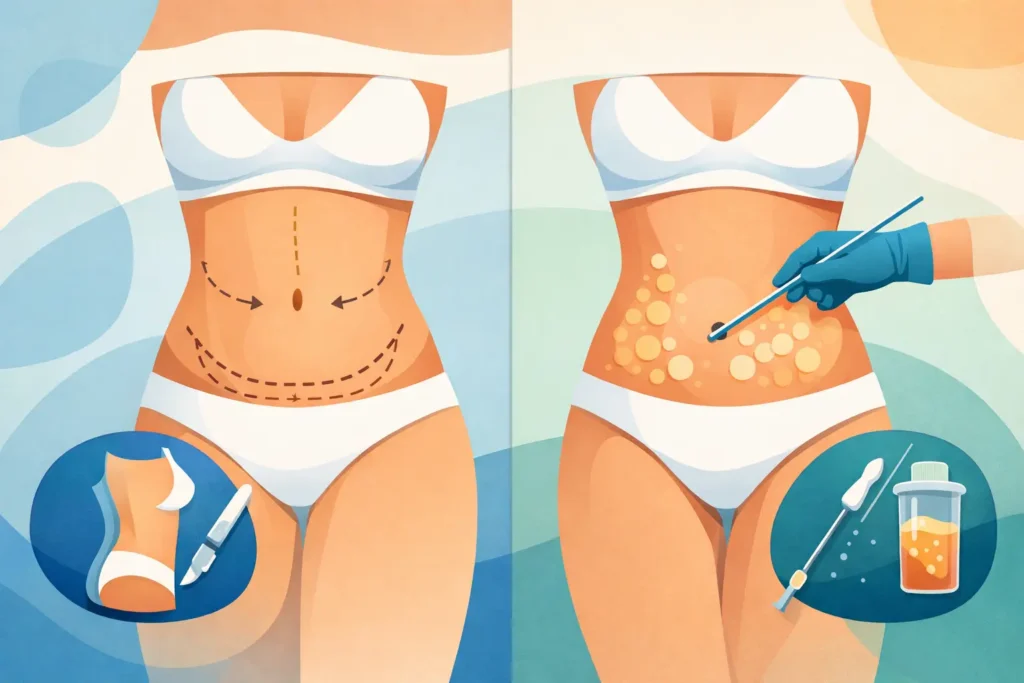
A flatter abdomen can look like a simple goal on paper, yet the path to it is rarely one-size-fits-all. When patients compare tummy tuck vs liposuction, they are often trying to answer a more personal question: do I need less fat, tighter skin, stronger abdominal support, or all three?
That distinction matters. Liposuction and tummy tuck surgery can both refine the midsection, but they solve different problems and create different kinds of change. Choosing well is less about following trends and more about understanding your anatomy, your priorities, and the level of correction you truly want.
Tummy tuck vs liposuction: the core difference
Liposuction removes localized fat deposits. It is designed to sculpt areas where fat remains resistant to diet and exercise, even when you are otherwise healthy and close to your goal weight. In the abdomen, this can improve contour by reducing fullness and creating a cleaner waistline.
A tummy tuck, or abdominoplasty, goes further. It removes excess skin, addresses laxity in the abdominal wall, and reshapes the lower abdomen with a more comprehensive surgical approach. For patients with stretched skin after pregnancy or significant weight loss, or with separated abdominal muscles, a tummy tuck treats concerns liposuction cannot correct.
In practical terms, liposuction is a fat-reduction procedure. A tummy tuck is a contour-restoration procedure.
Who is a better candidate for liposuction?
Liposuction tends to suit patients whose skin still has good elasticity and whose main concern is stubborn fat. These patients may feel that their abdomen looks thick or lacks definition, but they do not have hanging skin or a pronounced lower abdominal pouch caused by muscle laxity.
This is often the right option for men and women who maintain a stable weight, exercise regularly, and want refinement rather than structural correction. If the skin can contract well after fat removal, liposuction may create a beautifully natural improvement with smaller incisions and a shorter recovery than abdominoplasty.
That said, liposuction has limits. If loose skin is already present, removing fat alone can make that looseness more visible. A patient may be thinner, but not tighter. That is one of the most common reasons people feel underwhelmed when liposuction is chosen for the wrong anatomy.
What liposuction can improve
Liposuction can reduce abdominal fullness, improve the transition between the waist and lower torso, and refine areas such as the flanks. In carefully selected patients, it delivers elegant contouring without the longer scar associated with a tummy tuck.
What it does not do is tighten separated muscles or remove excess skin. It is a sculpting tool, not a skin-tightening operation.
Who is a better candidate for a tummy tuck?
A tummy tuck is often the better choice when the abdomen has changed in ways that cannot be reversed with exercise alone. Pregnancy, major weight loss, and aging can all stretch the skin and abdominal wall beyond their ability to rebound. In these cases, even very fit patients may still look distended or loose through the midsection.
If you see wrinkled skin, a lower belly overhang, or bulging that worsens despite strength training, a tummy tuck may be more appropriate. During surgery, excess skin can be removed and the abdominal muscles can be repaired when needed, creating a firmer and smoother foundation.
This is why many post-pregnancy and post-weight-loss patients find that abdominoplasty addresses the part of their body contour that exercise never fully changed. The result is not simply a smaller abdomen, but a more restored one.
What a tummy tuck can improve
A tummy tuck can flatten the lower abdomen, remove loose skin, reposition and refine the abdominal contour, and repair muscle separation. It is especially effective when the issue is not excess fat alone, but a combination of skin laxity, weakened tissue, and altered shape.
The trade-off is that it is a more involved operation. Recovery is longer than liposuction, and there is a permanent scar, typically placed low enough to be concealed by underwear or swimwear.
Skin, muscle, and scar considerations
When deciding between tummy tuck vs liposuction, three factors usually make the answer clearer: skin quality, muscle integrity, and scar tolerance.
Skin quality is central. Tight, elastic skin often responds well after liposuction. Thin, creased, or hanging skin usually does not. If your skin has been significantly stretched, removing fat may not create the polished result you are hoping for.
Muscle integrity also matters. Many patients, especially after pregnancy, have rectus diastasis, which is a separation of the abdominal muscles. Liposuction cannot repair that. A tummy tuck can.
Then there is the question of scarring. Liposuction uses very small access points, while a tummy tuck requires a longer incision. For some patients, avoiding a larger scar is a high priority. For others, the improvement in shape and skin tightening is worth that trade-off. A thoughtful consultation helps define which outcome matters more to you.
Recovery: what feels different after each procedure?
Liposuction recovery is generally more straightforward. Swelling and soreness are expected, and compression garments are usually part of the healing process. Many patients return to lighter activities relatively quickly, though final contour can take time to emerge as swelling settles.
A tummy tuck recovery is more demanding because the procedure is more extensive. Tightness, limited mobility in the early phase, and a longer pause from strenuous activity are normal. If muscle repair is performed, that adds another layer to healing. The recovery is not simply about looking better quickly. It is about allowing repaired tissues to heal properly so the result remains stable and refined.
For international patients, this difference is especially important. Surgical travel should be planned around the procedure you are actually having, not the one you hoped would be easier. Recovery timelines, follow-up needs, and support during healing all deserve careful attention.
Can liposuction and tummy tuck be combined?
Yes, and in many cases they should be. Patients often have more than one issue contributing to abdominal contour, such as excess fat at the flanks, loose lower abdominal skin, and muscle separation. In these situations, combining a tummy tuck with liposuction can create a more complete and balanced result.
This approach allows the surgeon to tighten the abdomen while also refining surrounding areas for better proportion. The goal is not to overcorrect. It is to create harmony across the waist, abdomen, and torso so the result looks natural from every angle.
An experienced surgeon will decide whether combining procedures is both aesthetically beneficial and medically appropriate based on your anatomy, health, and operative plan.
Tummy tuck vs liposuction after pregnancy or weight loss
This is where the distinction becomes especially relevant. After pregnancy, many women are not dealing with fat alone. They may also have stretched skin, weakened abdominal support, and changes in the lower belly that do not improve despite excellent fitness habits. In that setting, a tummy tuck is often the more satisfying option.
After major weight loss, the same principle applies. Once the body has changed dramatically, skin redundancy can become the main issue. Liposuction may remove additional fat, but if the skin cannot contract, the improvement may be limited.
There are exceptions, of course. Some patients after pregnancy or moderate weight loss still have strong skin elasticity and little muscle laxity. They may do very well with liposuction alone. This is why the best answer is anatomical, not theoretical.
How to decide with confidence
The right procedure should match the problem, not just the desired buzzword. If your abdomen feels heavy because of localized fat and your skin remains firm, liposuction may be enough. If your concern is a loose, stretched, or protruding abdomen, especially after pregnancy or weight changes, a tummy tuck is more likely to deliver the transformation you actually want.
The most elegant results come from precision, not excess. A surgeon with a strong eye for natural balance will assess how fat, skin, muscle, and body proportion interact before recommending surgery. At Dr. Hebert Lamblet Plastic Surgery, that level of planning is central to creating outcomes that look refined rather than overdone.
A beautiful result begins with an honest diagnosis. If you are deciding between the two, focus less on which procedure sounds simpler and more on which one truly addresses your anatomy. That is usually where clarity begins.
