
 Português
Patients often use the terms interchangeably, but the difference between breast augmentation and breast implants is not just semantics. One describes the overall procedure to enhance breast volume and shape, while the other refers to a device that may be used to achieve that result. Understanding that distinction can make consultations clearer, expectations more precise, and decisions far more confident.
For many women, this question comes up early. They know they want fuller breasts, better balance, or restored volume after pregnancy or weight loss, but they are not always sure what they are actually asking for. That is completely normal. Cosmetic surgery language can sound straightforward until the details begin to matter.
What is the difference between breast augmentation and breast implants?
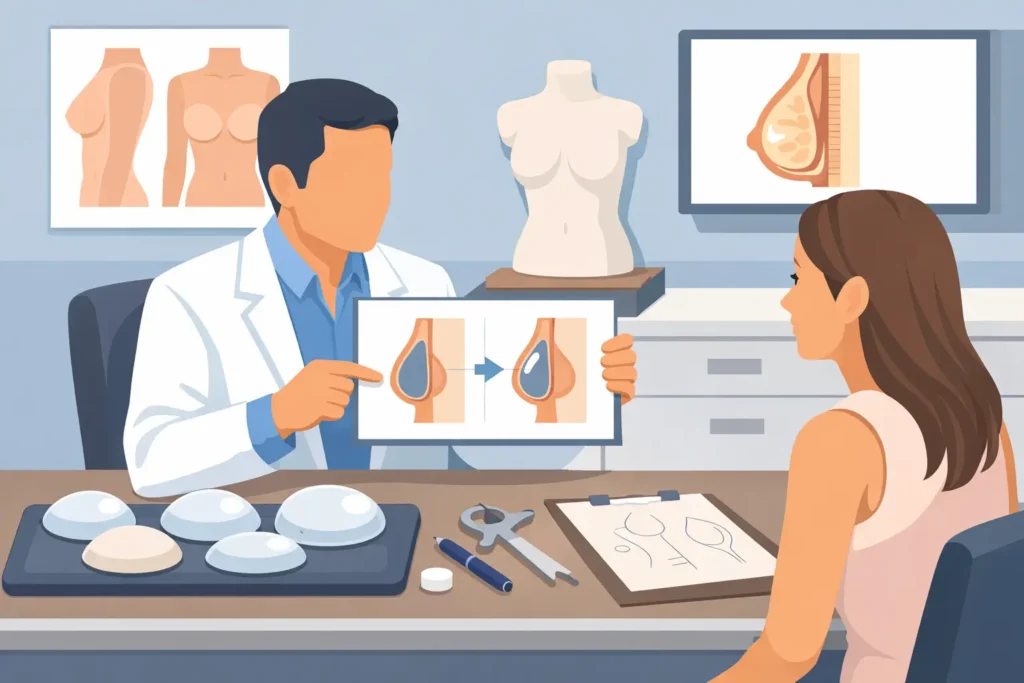
Breast augmentation is the surgical procedure designed to increase breast size, improve fullness, refine symmetry, or enhance overall breast proportions. It is the treatment plan. Breast implants are one of the tools a surgeon may use during that plan.
In other words, augmentation is the broader category, and implants are one method within it. A patient may seek breast augmentation and choose silicone implants, saline implants, or in some cases fat transfer. That is why saying “I want breast implants” and saying “I want breast augmentation” are not always identical statements.
This distinction matters because the procedure is not defined by the implant alone. Surgical technique, implant placement, incision choice, chest anatomy, skin quality, and the patient’s aesthetic goals all shape the final result. Natural-looking enhancement comes from the full strategy, not from the product by itself.
Breast augmentation is the goal
When a patient requests breast augmentation, she is usually describing the outcome she wants. That may mean more upper-pole fullness, a better fit in clothing, restored volume after breastfeeding, or improved proportionality between the breasts and the rest of the body.
Augmentation can also address asymmetry, where one breast is noticeably smaller or shaped differently than the other. In reconstructive or post-pregnancy contexts, the conversation may be even more nuanced. The goal is not always simply to go larger. Sometimes it is to restore what was lost and refine the silhouette in a way that looks elegant, balanced, and authentic to the patient.
Because augmentation is outcome-focused, the surgeon must evaluate more than cup size. The width of the chest, thickness of the tissue, nipple position, skin elasticity, and lifestyle all influence what approach will look and feel most harmonious.
Breast implants are the device
Breast implants are medical prostheses placed during surgery to add volume and shape. They are not the entire procedure. They are one component of it.
Most implants today are either saline or silicone. Saline implants are filled with sterile saltwater, while silicone implants are filled with silicone gel. Both have advantages, and the right option depends on anatomy, personal preference, desired feel, and the surgeon’s recommendations.
Silicone implants are often chosen for their softer, more natural feel. Saline implants can be appropriate in certain cases and may offer different incision or sizing considerations. There is no universally superior implant for every patient. The better question is which implant suits a particular body and aesthetic objective.
Implants also vary in profile, size, and shape. A moderate-profile implant and a high-profile implant can create very different looks, even if the volume is similar. That is another reason the phrase “breast implants” does not fully describe what a patient is choosing.
Not every breast augmentation uses implants
This is where the wording becomes especially important. Breast augmentation can also be performed with fat transfer, sometimes called autologous fat grafting. In this approach, fat is removed from one area of the body through liposuction, processed carefully, and then injected into the breasts to create modest volume enhancement.
A patient who chooses fat transfer is still having breast augmentation, but she is not receiving breast implants. That alone explains the difference between the two terms.
Fat transfer can appeal to women who want a subtle increase, a softer contour, or the benefit of body sculpting in donor areas such as the abdomen or flanks. At the same time, it has limitations. Volume increase is usually more modest than with implants, and not all transferred fat survives long term. For patients seeking a more dramatic size change or a very defined upper-breast contour, implants may remain the better choice.
Why the confusion is so common
In everyday conversation, people often use the most visible term for the whole process. Because implants are familiar, many assume they are the procedure itself. It is similar to confusing a treatment goal with the material used to achieve it.
That shorthand is understandable, but it can create confusion during research. A patient may think she wants implants when what she really wants is lifted breasts with restored fullness. In that case, augmentation alone may not be enough, and a breast lift could also be necessary. Another patient may assume augmentation always means large implants, when in reality it can be conservative, refined, and tailored to preserve a natural silhouette.
The real decision is more personal than terminology
Once the language is clear, the conversation becomes much more useful. The key question is not whether augmentation and implants are different in theory. It is what kind of enhancement suits your anatomy, preferences, and long-term goals.
Some patients want a very subtle change that no one can identify immediately, only notice as improved balance and elegance. Others want more visible fullness, especially in the upper breast. Some are replacing volume lost after pregnancy. Others have naturally small breasts and want proportions that feel more aligned with how they see themselves.
This is why an expert consultation matters. A meticulous surgeon does not begin with a stock answer. He begins with your anatomy and your goals.
Difference between breast augmentation and breast implants in practice
In practical terms, breast augmentation includes all of the planning decisions that create the final result. That means evaluating whether implants or fat transfer are appropriate, selecting implant type if implants are used, determining the ideal size range, choosing placement above or below the muscle, and deciding whether additional procedures such as a lift are needed.
Breast implants, by contrast, are only one part of that decision tree. They do not determine on their own whether the result will look natural, whether the breasts will sit beautifully on the chest, or whether the outcome will age well over time.
A sophisticated result depends on proportion. An implant that is technically well made can still look too wide, too projected, or too heavy for a patient’s frame if the surgical plan is not carefully customized. That is where artistry and technical precision matter most.
When a breast lift enters the conversation
Many patients researching augmentation are actually good candidates for a combined approach. If the breasts have descended, the nipples sit low, or the skin has stretched significantly, adding volume alone may not create the desired shape. An implant can fill the breast, but it does not correct meaningful sagging by itself.
In those cases, a breast lift may be recommended with augmentation. This often surprises patients who thought the choice was simply between implants and no implants. In reality, breast surgery is often about restoring structure as much as restoring volume.
That is another reason the phrase “breast augmentation” is more complete. It leaves room for the full surgical strategy rather than narrowing the discussion too early.
Choosing the right approach
The best approach depends on what you want to see in the mirror and what your tissues can realistically support. If you want a noticeable increase in size, rounder upper fullness, or more predictable volume, implants may be the most effective option. If you prefer a subtle increase using your own tissue and have enough donor fat, fat transfer may be worth considering.
If your breasts have lost position as well as fullness, combining procedures may offer the most graceful result. And if your priority is a refined, natural look rather than a dramatic transformation, that should guide every technical choice from sizing to placement.
For patients traveling internationally for surgery, clarity is especially valuable. It helps you ask better questions, understand recommendations, and feel secure in the treatment plan before you arrive. At Dr. Hebert Lamblet Plastic Surgery, that level of precision and guidance is part of what makes the journey feel more supported.
The right breast procedure should feel less like choosing a product and more like designing a result that fits your body beautifully. Once you understand the terminology, you can focus on what matters most – a surgical plan that respects your anatomy, reflects your goals, and enhances your natural beauty with confidence.
