
 Português
If you have been asking what is breast augmentation vs breast lift, you are likely not looking for a textbook definition. You want to know which procedure will actually address what you see in the mirror – loss of fullness, nipples sitting lower than before, stretched skin after pregnancy, or breasts that feel deflated after weight loss. These two surgeries are often discussed together, but they solve different concerns.
For many patients, the confusion starts with a simple assumption: if breasts look lower, adding volume will lift them. Sometimes it helps slightly. Often, it does not. In other cases, a patient wants fuller breasts but also wants to preserve a natural shape and elegant proportion, which may require more than implants alone. The right choice depends on anatomy, skin quality, nipple position, and the kind of result you want to live with long term.
What is breast augmentation vs breast lift in simple terms?
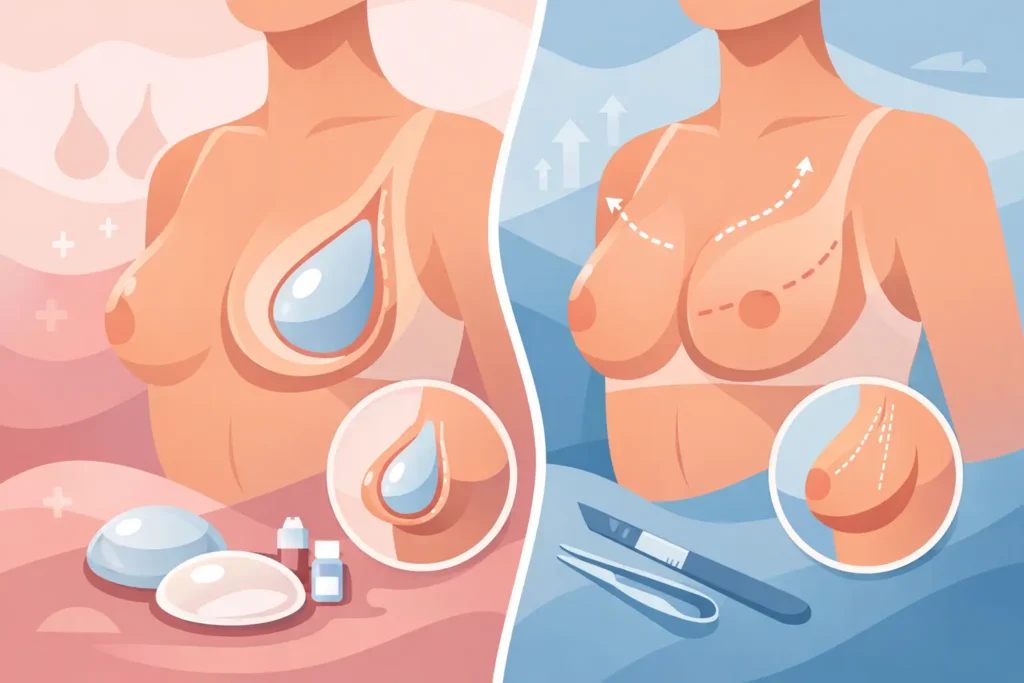
Breast augmentation is a procedure designed to increase breast volume and improve upper pole fullness. This is usually done with implants, and in select cases, with fat transfer. It is best suited for patients who want larger breasts, more projection, better symmetry, or restored fullness after pregnancy or weight changes.
A breast lift, also called mastopexy, reshapes and elevates the breast by removing excess skin, repositioning the breast tissue, and raising the nipple-areola complex to a more youthful position. The goal is not primarily to make the breasts larger. The goal is to improve shape, firmness, and position.
That distinction matters. Augmentation adds volume. A lift restores support and height. When patients compare breast augmentation vs breast lift, the real question is usually whether the concern is size, sagging, or both.
How each procedure changes the breast
Breast augmentation changes the breast from the inside out. By adding volume, it can create a rounder shape, increase cleavage, and improve fullness at the top of the breast. If the breasts have mild drooping, an implant may create a modest visual improvement because the added volume fills loose skin. But augmentation does not tighten skin in the way a lift does, and it does not reliably move the nipple higher.
A breast lift changes the breast from the outside in. It removes excess skin and reshapes the breast mound so the tissue sits higher on the chest. The nipple and areola can be repositioned to better align with the new breast contour. This is often what creates the refreshed, youthful look patients want after breastfeeding, aging, or significant weight loss.
One of the most common disappointments in cosmetic breast surgery happens when a patient chooses implants, hoping they will correct true ptosis, or sagging. If the nipple sits below the breast crease or points downward, a lift is often necessary to create a balanced result.
The signs you may need augmentation
Patients who benefit most from augmentation often describe their breasts as small, asymmetric, or lacking fullness. They may like the position of the breasts but want more volume, more curve in clothing, or a more proportional silhouette.
You may be a better candidate for breast augmentation if your nipples still sit in a youthful position, your breast skin has reasonable elasticity, and your main goal is to increase size. Some patients also choose augmentation to restore volume lost after pregnancy or weight fluctuation, even if they do not want a dramatic change.
The details matter here. A tasteful result is not only about cup size. Implant profile, width, placement, and the relationship between the implant and your natural tissue all influence whether the outcome looks soft, elegant, and in harmony with your frame.
The signs you may need a breast lift
A lift is often the better option when the breast has lost shape rather than simply lost size. This includes breasts that appear deflated, nipples that sit low on the chest, skin that feels stretched, or a breast mound that rests lower than it once did.
A simple at-home clue is this: if you place your hands under your breasts and lift them gently, and that lifted shape looks more like the result you want, a breast lift may be the missing piece. Patients in this group are often less concerned about becoming larger and more focused on looking firmer, more youthful, and more centered.
A lift does leave scars, and that is an important trade-off to discuss openly. For the right patient, the improvement in contour and nipple position far outweighs that concern. Scar patterns vary depending on how much lifting is needed, and meticulous surgical planning plays a major role in how refined the final result appears.
When you may need both procedures
Many patients do not fall neatly into one category. They want fuller breasts, but they also have sagging that an implant alone will not fix. In that situation, combining augmentation with a lift can create the most balanced and natural-looking outcome.
This combined approach is common after pregnancy, breastfeeding, or major weight loss. The breast may have empty upper fullness, stretched skin, and a lowered nipple position all at once. A lift restores the breast to a more youthful position, while augmentation adds volume where it has been lost.
This is also where surgical judgment matters most. Adding too much implant volume to a breast that already has weak skin support can create a heavy result that ages faster. A more refined plan often prioritizes proportion, tissue quality, and lasting elegance over dramatic size.
Breast augmentation vs breast lift: recovery and scars
Recovery for either procedure depends on the exact surgical plan, your healing pattern, and whether the surgery is performed alone or in combination. In general, breast augmentation often involves swelling, chest tightness, and activity restrictions early on, while a breast lift may involve more incision care and scar management because the skin envelope has been reshaped.
Scarring is another clear difference between the two. Augmentation scars are typically smaller and placed discreetly, often in the breast fold or around the areola, depending on technique. A breast lift requires more visible incisions because excess skin is being removed and the nipple is repositioned.
Patients sometimes focus heavily on scars before surgery, then realize afterward that breast shape was the issue affecting confidence all along. Still, this is never a detail to minimize. A careful conversation about incision placement, healing expectations, and long-term scar quality is part of responsible planning.
How to choose the right procedure
The best way to decide is not by choosing the surgery you have heard most about. It is by identifying the specific change you want. If you want larger breasts with better fullness and your breast position is still relatively youthful, augmentation may be enough. If you are happy with volume in a bra but dislike the droop or stretched appearance without support, a lift may be more appropriate. If you want both size and elevation, a combined surgery may offer the most complete result.
Photographs, physical examination, and nipple position all help guide the decision. So does lifestyle. A patient who wants subtle enhancement may choose a different path than someone seeking a more dramatic transformation. Age alone does not determine the answer. Anatomy does.
For patients traveling for surgery, clarity matters even more. You want a surgeon who evaluates not just your wish list, but the structural realities of your tissue, skin, and proportions. That is how beautiful outcomes stay believable.
The value of a surgical plan tailored to you
Beautiful breast surgery is not about choosing between two popular terms. It is about understanding what your body needs to achieve a result that feels refined, balanced, and authentically yours. At Dr. Hebert Lamblet Plastic Surgery, this approach is centered on precision, natural aesthetics, and thoughtful planning for each patient, including those traveling internationally for care.
If you have been comparing breast augmentation vs breast lift, the most helpful next step is to stop asking which procedure is better in general and start asking which one is better for your anatomy and goals. The right answer is the one that restores confidence without asking your body to pretend to be something it is not.
